8 min read · 2026-09-05
Custom 10x10 Canopy Tent With Company Logo: Artwork Guide
Exactly how to prepare a logo for a printed canopy: file types, resolution, safe areas, color matching, and where a logo should sit so it reads from across the lot.
Quick answer
For a custom 10x10 canopy tent with a company logo, supply vector artwork (AI, EPS, PDF or SVG) or a 150 dpi raster file at full size. Place the logo on the valances for ground-level readability and repeat it on the canopy top for elevated views. There are no per-color fees, and a free rendered proof is issued before production.
Where a logo actually gets seen
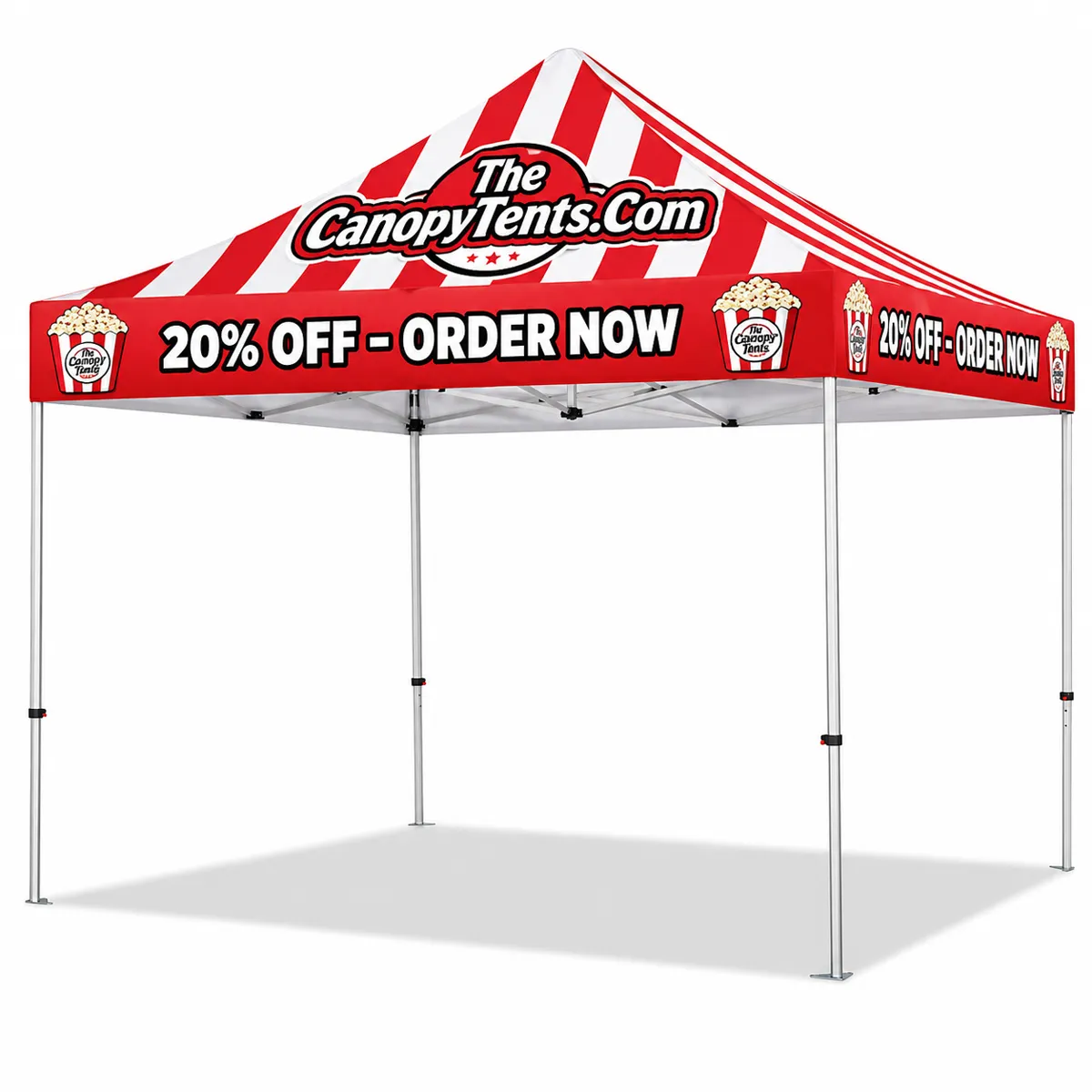
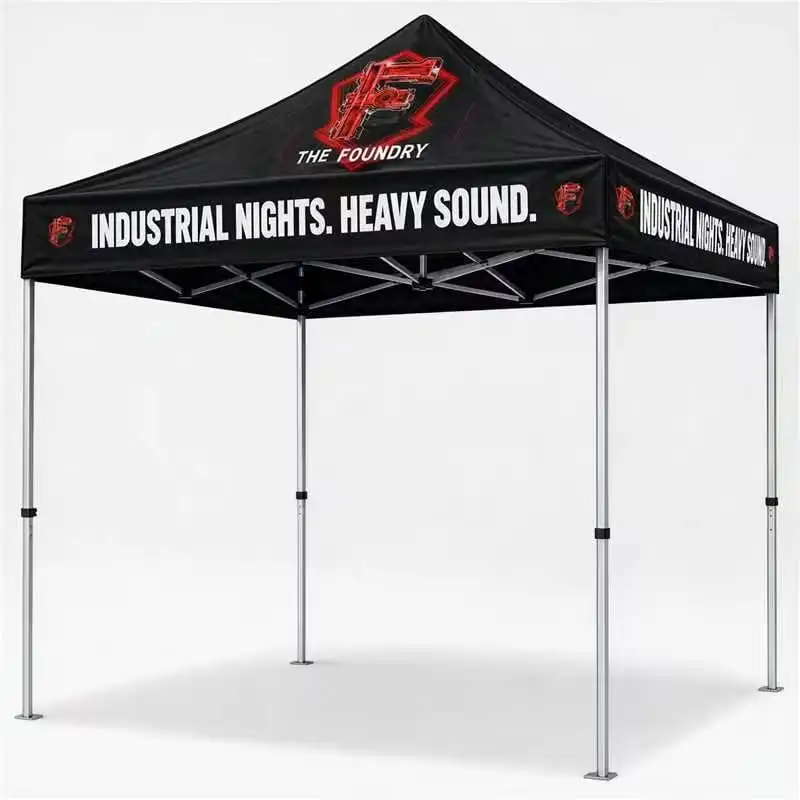
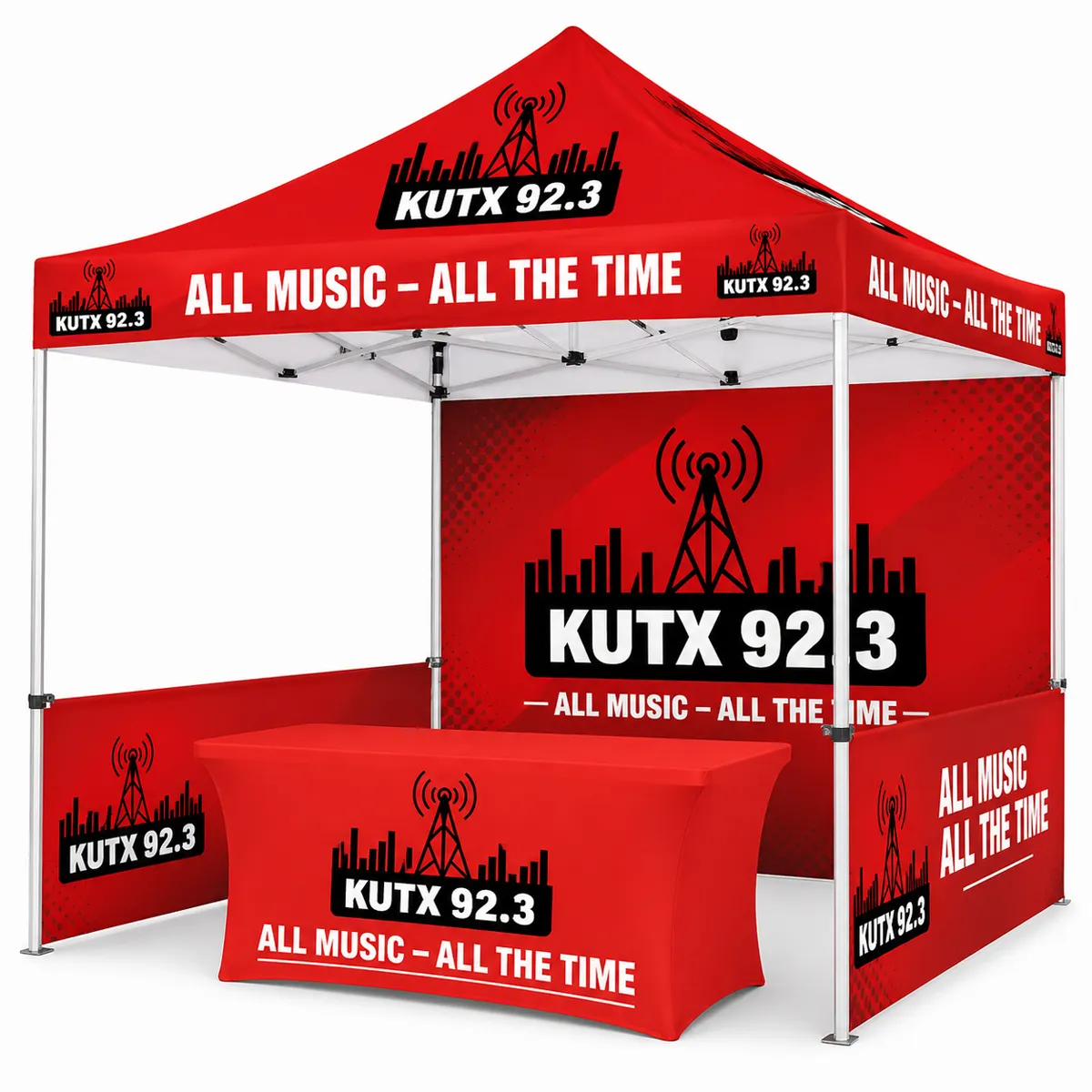
The most expensive layout mistake is putting the logo only on the roof. On a 10x10, the canopy top is visible from balconies, drone shots and second-floor windows — great for photos, useless for the person standing thirty feet away. The valance, the eight-inch band that hangs from the roof edge, is at eye level and is what the crowd reads. A well-planned printed canopy tent repeats the mark on all four valances, adds it once to the peak, and treats the roof as a bonus surface.
| Surface | Visible from | What to put there | Priority |
|---|---|---|---|
| Valance (4 sides) | Eye level, 10–60 ft | Logo + one short line of copy | Highest |
| Canopy top | Above, drone and photos | Large logo or brand pattern | Medium |
| Peak | Angled approach views | Small logo repeat | Medium |
| Back wall | Inside booth, photo backdrop | Logo + value proposition | High |
| Half walls | Aisle level, counter line | Product names or a URL | Optional |
File formats that print cleanly
Vector artwork is always best: AI, EPS, PDF or SVG scale to a ten-foot canopy without softening a single edge. If you only have a raster file, it needs to be roughly 150 dpi at final print size — for a 10x10 top that means a very large file, and a 500-pixel logo pulled off a website will look blurry no matter what the print process is. Send what you have through the artwork upload page; our team will tell you honestly whether it holds up or needs a rebuild, and rebuilding a simple logo is included.
- Best: AI, EPS, PDF, SVG — infinitely scalable vector
- Acceptable: PNG or TIFF at 150 dpi full size, transparent background
- Risky: JPG pulled from a website, screenshots, logos embedded in slide decks
- Include your brand's Pantone or hex values so color is matched rather than guessed
Color: what dye-sublimation can and cannot match
Dye-sublimation on polyester produces saturated, durable color that survives rain, UV and years of folding because the ink lives inside the fiber. It is a CMYK process, though, so a handful of Pantone spot colors — particularly bright oranges, some greens and metallics — land close but not identical. If your brand hinges on an exact corporate red, say so up front and we will match against the closest achievable value on the proof rather than surprising you after production. The same profile is used across the whole catalog, so a canopy, a printed table cover and a feather flag ordered together will match each other.
Type sizing: the ten-foot test
Booth copy fails when it is written like a brochure. Your valance has roughly eight inches of vertical space and a moving audience. Use one line: the brand name, or the brand name plus a four-word descriptor. Cap height of two to three inches is readable at about thirty feet, which is the width of a typical vendor aisle. Save details — pricing, service lists, QR codes — for the A-frame sign at the booth entrance and the banner stand beside the table, where people stand still long enough to read.
If a visitor cannot name your company from across the aisle without stopping, the graphics are doing the wrong job — no matter how beautiful the file looks on screen.
Safe areas, seams and the parts that get hidden
A canopy is a three-dimensional object, not a flat poster. The roof curves over the truss bars, the corners wrap, and the top few inches of each valance sit in shadow. Keep critical elements at least two inches inside the trim edge and avoid placing a logo directly across a fold line. Our proof shows the artwork mapped onto a rendered canopy precisely so these issues are visible before printing — approve the render, not the flat file.
Proof, production and reprints
The workflow is deliberately simple: send the logo, receive a rendered proof within 24 hours, request changes as many times as you need, approve, then production runs about five business days with free continental US shipping. Because the canopy top is a separate SKU from the frame, a rebrand two years from now means ordering a new printed top and keeping the hardware — a fraction of a full replacement. Teams that want the whole booth branded in one order usually start from a Gold tent package, which bundles canopy, walls and accessories on the same artwork file.
Wherever you exhibit — a farmers market in Dallas, a convention plaza in Las Vegas, or a campus fair — the artwork rules do not change. Big mark, short message, high contrast, printed on the surfaces at eye level. Everything else is decoration.
Frequently asked questions
- What file format do you need for a custom canopy logo?
- Vector files (AI, EPS, PDF, SVG) are ideal. Raster files should be about 150 dpi at full print size with a transparent background.
- Can you match my exact brand colors?
- Dye-sublimation is a CMYK process that matches most Pantone values closely. Send your Pantone or hex codes and the proof will show the achievable match.
- Do you charge for design work?
- No. Send a logo and our designers build the canopy layout, then you approve a free rendered proof before production.
- Where should the logo go on a 10x10 tent?
- On all four valances first, because that is eye level, then repeated on the canopy top and peak.